














Ask any childcare director what the most expensive guess they make every year is, and a lot of them will say the same thing: how many classrooms to open, and when. Open a room too early and you're carrying staff costs against empty seats. Open it too late and you're turning away families who needed care weeks ago, families who often don't wait around for you to catch up. Miscalculations are common, but can be expensive because most centers are making this call based on last year's enrollment numbers and a gut feeling.
Having your own data organized, visible, with easy-to-read metrics can significantly help, but it can get tricky to pull comparison reports on your own. When a center has its historical enrollment and attendance patterns in one place, instead of scattered across spreadsheets, paper files, and memory, the seasonal patterns tend to become obvious pretty fast. Maybe infant enrollment consistently dips in January and climbs back in March. Maybe a specific classroom runs under capacity every summer because families travel. None of this is a secret once you can actually see it. The problem most directors have isn't that the pattern doesn't exist, it's that they don’t see it fast enough to plan ahead.
We can’t call ourselves fortune tellers, but this is what Kangarootime's Insights tools are built to support. To be clear about what that means: the tool doesn't predict the future for you. What it does is take the historical enrollment and attendance data you're already generating and make the patterns visible, so you're planning your next classroom decision based on the numbers your center has supported before.
The Costs You Can See, and the Ones You Can't
Some of the costs of getting classroom timing wrong are the ones directors can see immediately, the kind that show up the moment someone sits down and crunches the numbers. An empty seat is lost revenue you can calculate on the spot. A family that sat on a waitlist and moved on before a spot ever opened is a cost most directors can feel, even without pulling up a report.
The harder costs to catch are the hidden ones, the ones tied to understaffing a center and burning out teachers. Understaffing doesn't always look like a crisis in the moment. It can often show up through classrooms running too lean, staff burnout, and eventually causing unexpected turnover. Research from the Federal Reserve Bank of Minneapolis, using national survey data on early childhood centers, found that turnover is directly tied to how well staff are supported and compensated: centers averaging under $10 an hour see 23.1% annual staff turnover, compared to just 7.5% at centers paying $25 an hour or more. The Federal Reserve Bank of Cleveland found the same instability at a broader level, turnover in childcare work in 2022 ran about 65% higher than in a typical job. Compiling staffing and enrollment figures, determining what your hourly takeaway is, and using that metric as a planning and support tool can help. The real differentiator is being able to layer that on top of historical metrics to estimate seasonal shifts and hourly enrollment shifts to keep staff and children supported.
The Right Data Speaks for Itself
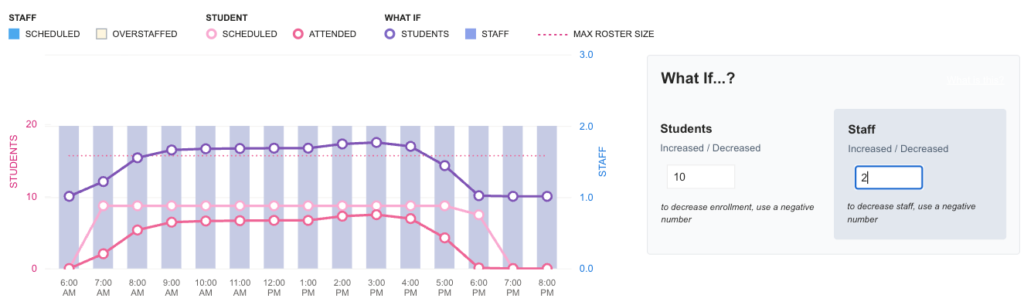
In this scenario, a director is looking at adding 10 new students from the waitlist to Monday and Tuesday. The pink dotted line represents the current maximum roster size based on existing staff. The purple hourly columns show how that could adjust if additional staff is added.
Monday:
Tuesday:
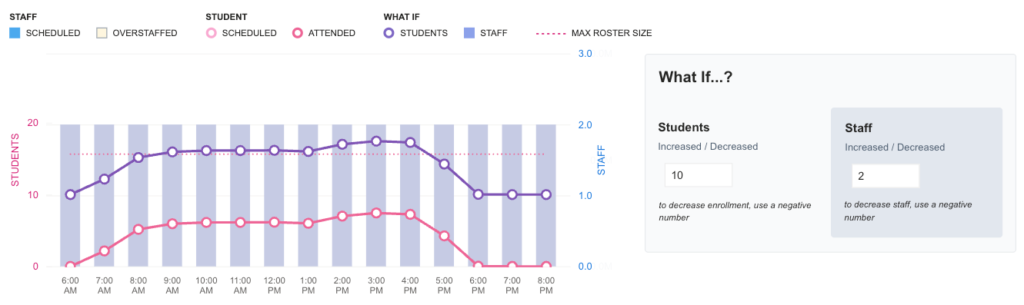
Based on attendance and staffing data, this director can see the times when budgeting for 2 new staff members during peak hours (8am to 4pm) on Mondays and Tuesdays could bring 10 new students into the center while still remaining compliant. Individual hours can be highlighted to further understand how staffing needs to adjust throughout the day. If enrollment peaks between 2pm-5pm for after school care, then directors can plan appropriate shifts for full and part time staff so children are cared for and your center stays profitable.
More data over time allows for even clearer, revenue saving support. If you’ve never sat down and mapped enrollment patterns against your staffing plan, that’s a half day well spent before your next fiscal year starts, and a way to cut down on lengthy waitlists.
Ready to get started?
Kangarootime helps to easily visualize this data and support childcare centers to grow their business. Chat with one of our experts today and get started!